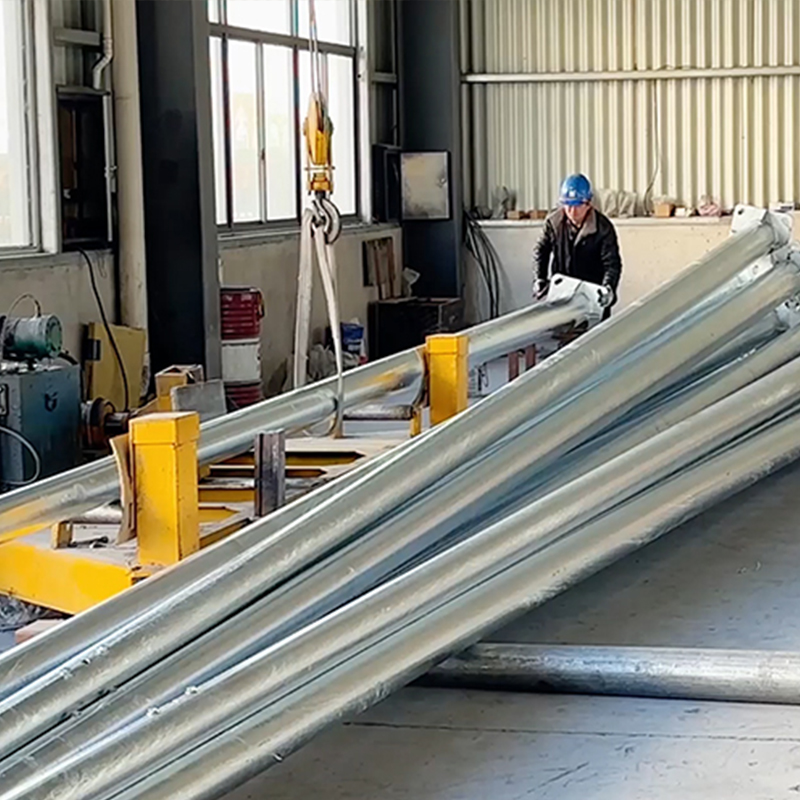
Even with basic qualifications, beginners may still fall into operational pitfalls due to inexperience. These "traps" often stem from misinterpretation of equipment characteristics, disregard for process logic, or oversights in details. Let's break them down one by one:
1. Skipping Pre-treatment Before Direct Operation: Hidden Safety Risks Some beginners mistakenly believe "alignment equals rigid pressing," securing deformed lamp poles onto machinery without inspection. In reality, pre-treatment is a critical prerequisite: First observe the pole's curvature (natural sagging or deformation from external force), measure bending amplitude (using pull wires or laser rangefinders to mark vertices), and inspect for cracks or rust (using magnetic particle testing or percussion sound detection). Hidden cracks may cause fractures and debris if pressure is applied directly; inaccurate vertex positioning can exacerbate localized deformation. A case involved a beginner slipping during clamping due to uncleaned pole surfaces, resulting in sudden pressure head displacement and hand injury—this highlights that pre-treatment serves not only as a technical procedure but also as a safety barrier.
2. Blind pursuit of "one-time straightening to perfection" compromises material performance. Novices often rush for quick results, believing that "higher pressure and longer duration yield better straightening outcomes." However, the elastic modulus and yield strength of lamp posts determine their deformation limits: excessive pressure causes materials to enter plastic deformation, leading to hardening and brittleness (i.e., "work hardening"), which increases fracture risks during subsequent use. Repeated pressure application at the same location may trigger "stress accumulation," forming microscopic cracks invisible to the naked eye. The correct approach should involve "staged, incremental pressure application": initially applying pressure to 60%-70% of the bending capacity, maintaining pressure for 3-5 seconds to observe rebound; then adjusting secondary pressure parameters based on rebound measurements until straightening requirements are met (typically ≤3‰ of post length). This trial-and-error refinement process fundamentally respects material characteristics.
3. Neglecting equipment condition monitoring often escalates minor malfunctions into major issues. The stable operation of lamp post
straightening machines relies on three critical factors: hydraulic system pressure stability, adequate lubrication of transmission components, and sensitive control system signals. A common rookie mistake is "focusing solely on workpieces while ignoring equipment maintenance." For instance, continuing operations when hydraulic oil levels drop below the mark (causing pump body wear from idle rotation), forcing press head movement despite rail slider jamming due to oil depletion (exacerbating guide rail deformation), or failing to promptly clean dust-covered limit switches (triggering overtravel accidents). These issues initially manifest as abnormal noises or sluggish movements, but prolonged neglect may lead to catastrophic failures like hydraulic pipe ruptures or motor burnout – not only compromising operational efficiency but also endangering personnel safety.
4. Perfunctory clamping and workpiece displacement lead to accidents. During lamp post straightening, fixtures (such as V-blocks or pressure plates) must rigidly secure the workpiece to the equipment's reference plane. Novices often simplify fixation procedures for speed: applying pressure plates only on one side (without symmetrical locking), omitting rubber anti-slip pads on fixture-contact surfaces (causing slippage during compression), or neglecting to check ground bolts' tightness (resulting in equipment displacement). During one operation, the fixture failed to lock properly, causing the lamp post to suddenly eject mid-straightening process and collide with adjacent equipment, triggering chain damage. This incident highlights that clamping fundamentally requires establishing a force-sharing mechanism between workpiece and equipment – any loosening may cause the straightening process to spiral out of control.
5. Personal protection measures often become mere formalities with weak risk awareness. Some novice operators mistakenly believe that "the calibration machine's slow operation pace and controllable force" justify relaxed safety protocols: skipping goggles (to avoid splashed metal fragments entering eyes), wearing regular cloth shoes (leaving feet unprotected during unexpected press head drops), and standing directly in front of the press head for observation (instead of maintaining a safe distance to the side). In reality, although the press head's descent speed of calibration machines is adjustable, the hydraulic system's instantaneous impact force may still exceed human tolerance limits. Oxidized layers or welding residues adhering to lamp post surfaces could fracture and fly during calibration. Protective equipment is not an "extra hassle," but the final line of defense for life safety.
Cutting Equipment,
Welding Equipment,
Straightening Equipment,straightening machines.Advanced Automatic Light Pole Welding Machine.